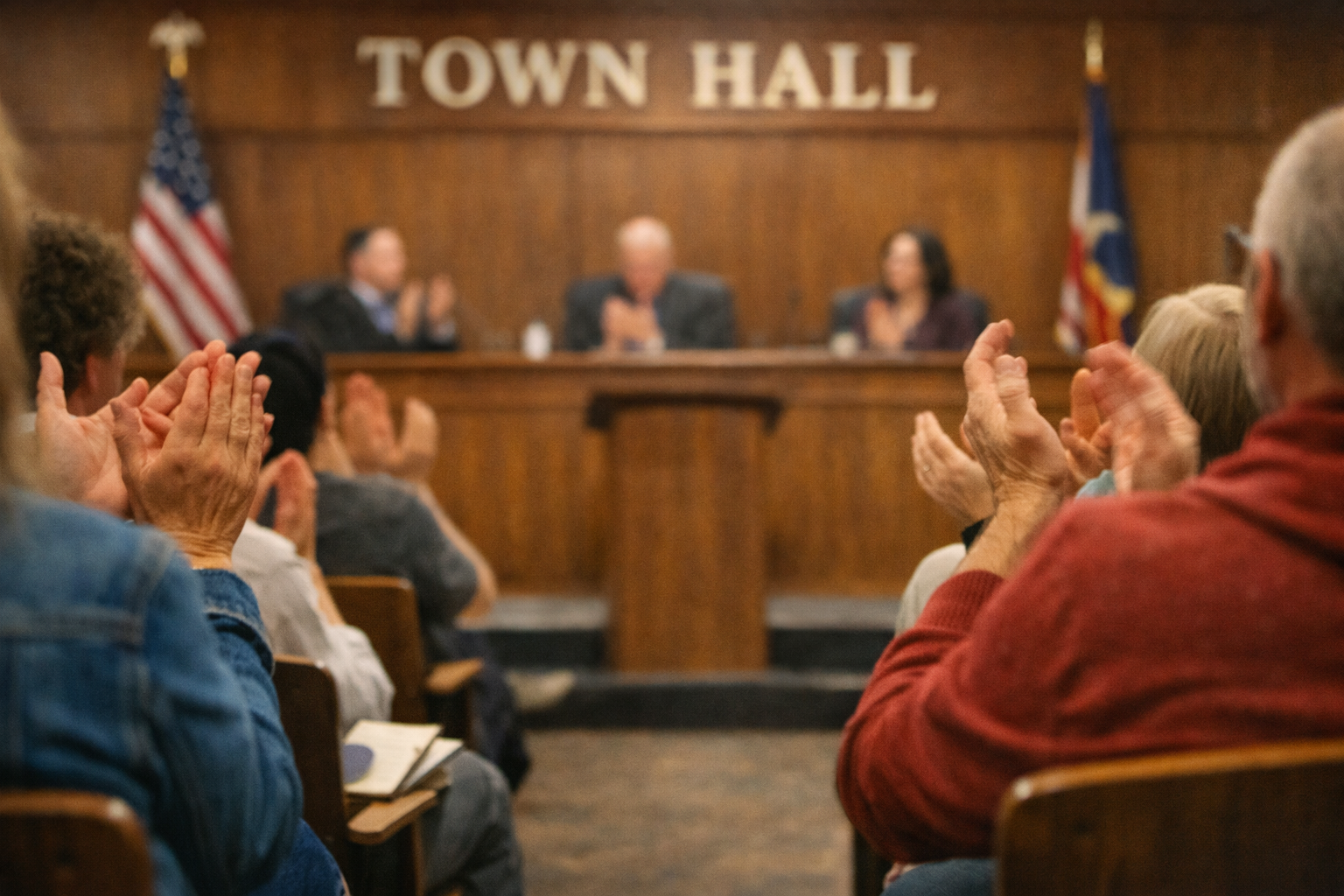
A few days ago, I was reading the Metro section of the Washington Post and saw a quote from Tami Pyfer. What?! It was an article about a public hearing in Takoma Park, about five miles from my house. What was my Dignity Index colleague, Tami Pyfer, a native of Utah, saying about my neighboring town?
It turns out a controversy had broken out in a Takoma Park City Council meeting, and the reporter had reached out to Tami for comment.
Good choice! Tami was an elected member of the City Council in Logan, Utah. She was an elected member of the Utah State Board of Education. She was the education advisor for Governor Gary Herbert during the disruption and dislocation of schools during COVID, and she was widely quoted during a press conference for imploring people to give each other grace during this difficult time.
Also, Tami is a co-creator of the Dignity Index.
The reporter asked Tami to comment on the pushback after Takoma Park’s mayor, Talisha Searcy, had asked people at the meeting to “refrain from cheering, booing, signs, all that good stuff.”
When the Mayor later responded to applause by asking people again not to clap or boo, some citizens erupted. One town resident said: “You’re not the dictator … this is outrageous!” Another person said, “This is freedom of speech!!!”
Tami, who’s been invited to give countless talks to state and national meetings of the Leagues of Cities and Towns, told the Post, “Democracy thrives on debate. We’re asking that in those debates, when we have disagreements, we make space for people to express themselves.”
In other words, Tami was making the point that the appeal for restraint had a legitimate purpose—to encourage free speech.
That was not the view of one unhappy citizen who said of the no-clapping request, “It’s not—I don’t think—legal. I would like to have proof that it is. And if it is, I will be fighting to make sure we overthrow that.”
If she had taken her complaint to court, she might have been reminded that, in a court room, she couldn’t cheer or boo. There are rules against that.
If she had pushed for legislation against a no-clapping rule, she might have discovered that she can’t clap or boo at legislative hearings. There are rules against that.
And the rules are not at the expense of free speech—but on behalf of it.
A few years ago, I attended a book talk by David Sengeh, then the Education Minister of Sierra Leone. As a Cabinet Minister of an African nation, Sengeh had to try to accommodate vastly different interests and opinions—from the most traditional and conservative to the most modern and liberal. It was hard work.
He explained by saying—in this room, for example, we have many different points of view. That’s good. We need to try to have all opinions represented. But it’s not just whether you’re in the room, it’s whether you’re at the table. And it’s not just whether you’re at the table, but whether you’re speaking. And it’s not just whether you’re speaking, but whether you’re saying what you really think.
… whether you’re saying what you really think.
The job of an Education minister, or a governor, or a mayor is to create policy that serves the community, that advances the public good, which means you have to take people’s opinions into account before you make the policy. And to know their opinions, you have to try to get them to say what they really think.
It is hard to say what you really think in public. Especially when people are clapping for the other view. In that climate, a lot of people are just not going to speak up. And it makes it all the harder to find out what people really think.
This is where freedom of speech comes in—and not always in the ways we think. If you want to protect freedom of speech, you have to make sure everyone feels free to speak. As we say in our Dignity Index presentations: You say what you think—but in a way that encourages others to say what they think.
That’s not easy. Frankly, I can relate to the people who said “This is free speech!” when they were told not to clap. It’s jarring when you’re unexpectedly told that you can’t do something you want to do and have always done … especially when it involves expressing your feelings. So, honestly, I was kind of on their side as I read the article.
But Tami’s comments brought me back to the main principle: free speech means everyone feels free to speak.
Greg Lukianoff, a First Amendment lawyer and the founder of FIRE—Foundation for Individual Rights and Expression—stands up for free speech all over the country, and it often puts him on the side of people whose political views he opposes!
If you’re not protecting the free speech rights of people who oppose you, you might not be protecting free speech at all.
Greg has said, “Free speech protects the powerless.” He says you need special protection for freedom of speech only for people who are either unpopular with the powerful or unpopular with the majority.
It’s an extraordinary thing—to create a community or a culture or even a public meeting that invites and encourages everyone to say what they really think. It’s a precious recognition of individual rights, wedded to a deeply human understanding of how hard it is to speak up in public. Creating that climate can require, in certain circumstances, a great deal of discipline and restraint from all of us, even if it means that, from time to time, we agree not to applaud our own opinions.
Tom